Sixty miles took nine hours. Don Curci sent the first photographs from the road, shot through the windshield: a dirt track cut into a forested hillside, ruts deep enough to hold standing water, a pickup ahead with its load lashed under a brown tarp, and below the track a pale river winding between the ridges.
The flood came on 26 August, when a glacier gave way high on Langtang Lirung and came down the Trishuli and the rivers feeding it. Nepal has counted 1,369 dead and 5,132 missing as of 9 September, with 8,317 houses destroyed, and all three figures are provisional. Don did not say which valley he was standing in, so neither does this page.
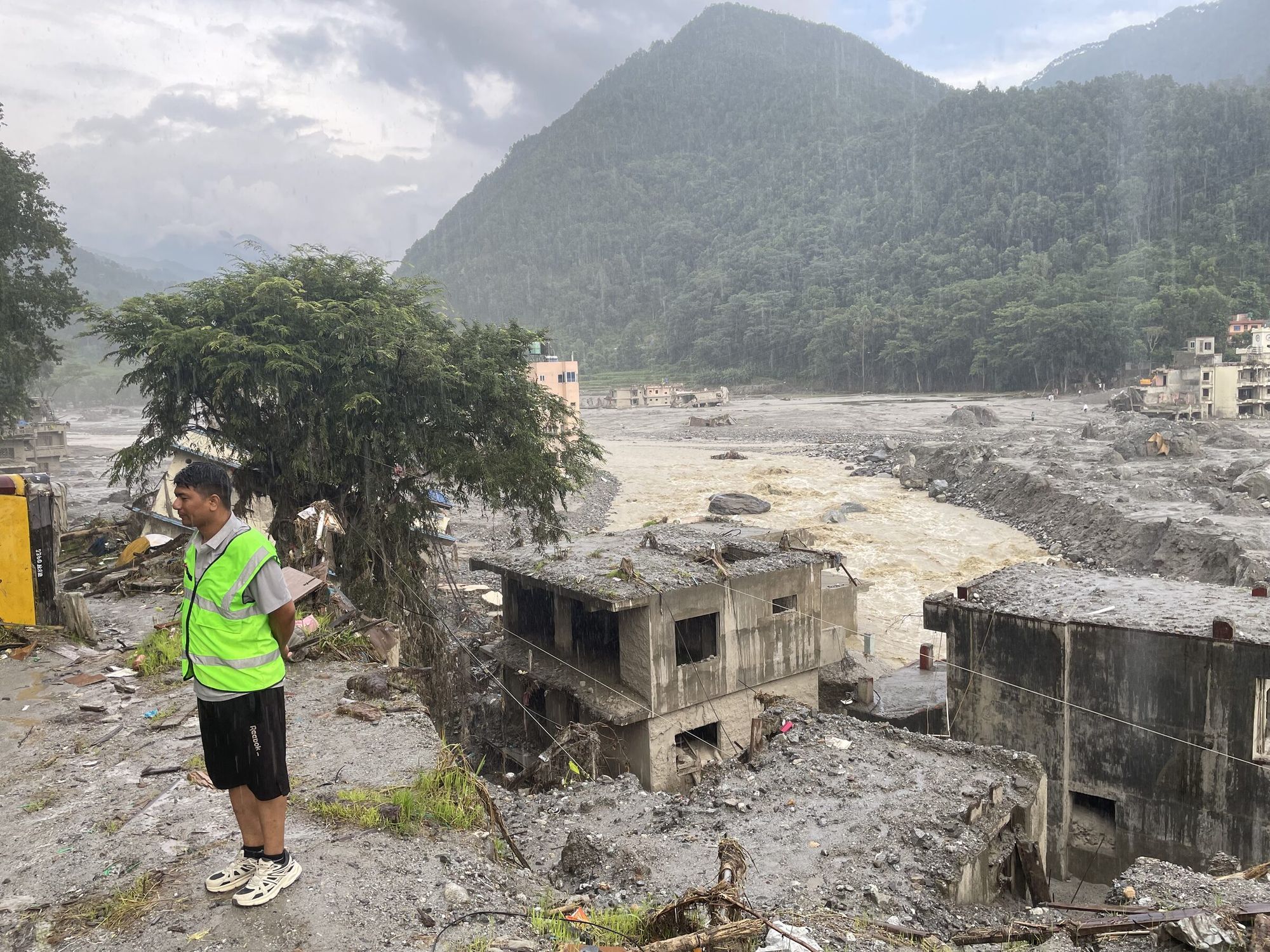
Then they arrived. Don sent a video and one line with it: there was once a big city here, and this is all that remains. The valley floor is gray mud from one side to the other, with braided channels of water still running across it and two concrete buildings broken and half buried at the edge. The hillside above is coated gray up to the line where the fields turn green again.
It was raining, and the river was still running high and brown. A concrete house sits stripped to its frame in the silt. Across the water, damaged buildings line a wide gray flood plain. A three-story building leans in the river bed at a steep angle, its windows empty, its floors cracked apart, uprooted trees and crumpled roofing metal in the mud in front of it.
Another building still stands with its upper floor intact and its signs still up. The lower floors are torn open and packed with mud and broken timber, and uprooted tree trunks lean across the roof. Thirty bodies were taken out of here, Don wrote. A yellow school bus lies on its side in the mud beside a road, a partly collapsed building behind it. The flood fills the full width of the valley past a row of houses. Another village gone.
Everyone receiving supplies had lost family members and their home. Under a shelter out of the rain, a boxed gas stove and a pressure cooker pass from one pair of hands to the next. An older man takes a pressure cooker, a pot and a stove, cartons of stoves stacked high against the wall behind him. Another holds a folded quilt in both arms. Two men pass a large pale green quilt across to a third.
Loading happened at night outside a house, beds and tailgates stacked with cartons of two burner gas stoves. Before that the supplies were laid out in a yard: plastic basins and buckets packed with aluminum pots, lids, mugs and utensils, woven sacks and bundles of folded cloth, and boxed pressure cookers stacked several layers high on the pavement outside a shop. The Silent Partner brought as much in supplies as would fit in two vehicles.
Don credits tremendous donations from many people in America. More is on its way to other areas.